

services

Leitat is a Verification Body accredited by ENAC with accreditation No19/VV036, in accordance with ISO/IEC 17029 and ISO 14065, specifically for the validation of energy saving certificates (CAE) in standardized actions.

An Energy Saving Certificate (ESC) is an electronic document that guarantees that, after carrying out an energy efficiency action, a new final energy saving equivalent to 1 kWh has been achieved. In this way, if an action is undertaken that results in an annual savings of 30.000 kWh, 30.000 ESC can be obtained.
This instrument allows energy savings to be monetized, recovering part of the cost of investments in energy efficiency (change of lighting, improvement of thermal insulation, renovation of industrial or domestic equipment, etc.), since the end user may receive a payment by selling the savings achieved for subsequent certification through the ESC System.
The actions may be:
Standardized, those easily replicable and included in the Ministry’s Catalogue of Sheets
Singular, those more complex or particular, not included in the catalogue.
The CAE System involves the agents described below. The participation in the process by each of them is as follows:
Obligated parties (SO): these are companies marketing gas and electricity, wholesale operators of petroleum products, and wholesale operators of liquefied petroleum gases and petroleum products and LPG, which are required to achieve a certain amount of energy savings per year.
Delegated parties (SD): accredited company that helps the obligated parties to achieve CAE, committing to settle a certain amount of CAE on their behalf each year.
Owner of the savings: the one who has carried out the investment in an energy efficiency action.
End user: the one who obtains a positive impact from the efficiency action, and usually coincides with the original owner of the savings.
Energy savings verifier: entity accredited by ENAC that reviews that the action has been carried out, that the documentation is correct, and that the declared energy savings have been achieved.
Representing the Administration are the Regional Managers and the National Coordinator of the CAE System.
The Intermediaries are installation or engineering companies that may work for the rest of the agents who may become owners of energy savings.
As summarized in the process diagram available on the MITECO website.
You can request information on the status of a declaration.

A CAE is a document certifying the energy savings achieved after an energy-efficiency measure has been implemented. It forms part of Spain’s Energy Savings Certificate system and can be converted into economic value for the party implementing the measure.
Generating CAEs enables a company to monetise the energy savings achieved through energy-efficiency measures. The system makes it possible to monetise these savings, improve the return on energy-efficiency investments and contribute to energy-saving targets. Leitat can participate in the savings verification process within the scope of its accreditation.
If a company (or an individual) has carried out an intervention that generates final energy savings, it can contact an obligated or delegated party, which will make an offer to purchase the savings generated. The obligated or delegated party will carry out the entire process leading to the issuance of the Energy Savings Certificate (CAE). It will compile all the documentation needed to substantiate the application, submit the case to one of the verifiers accredited by ENAC and, once a favourable opinion has been obtained from the verifier, electronically submit the CAE issuance application to MITECO for validation and final issuance of the certificate.
The following are considered obligated parties: electricity retailers, natural gas retailers, wholesale petroleum product operators and wholesale liquefied petroleum gas operators, regardless of whether or not they recorded energy sales in a given year (Law 18/2014 of 15 October, Article 69).
Obligated parties are required to contribute to the Spanish National Energy Efficiency Fund (FNEE). Since the CAE scheme entered into force, these contributions may be met using energy savings certificates.
The list is included in Annex II to the ministerial order on mandatory contributions to the Spanish National Energy Efficiency Fund, which is published annually (Law 18/2014 of 15 October, Article 70).
By way of example, the 2026 Order on mandatory contributions is provided. The Energy Savings Certificate System – Regulations section of the Spanish Ministry for the Ecological Transition and the Demographic Challenge website contains a link to the current order on mandatory contributions.
A delegated party is a legal entity that has previously been accredited as such by the National Coordinator of the CAE System (Royal Decree 36/2023 of 24 January, Article 9; Order TED/815/2023 of 18 July, Article 3).
The list of delegated parties accredited for the CAE System is available in the Agents section of this website.
A CAE must be verified by a verification body accredited by ENAC. Leitat is accredited by ENAC in accordance with RDE-33, ISO/IEC 17029 and ISO 14065 to verify energy savings declarations, ensuring the independence, technical competence and reliability of the verification process within the scope of its accreditation.
Leitat can verify standardised measures. Standardised measures are energy-efficiency measures predefined by the public authorities, with savings calculated using a standard method and no need for individual measurement in the agricultural, industrial, tertiary, residential and transport sectors.
Measures that can generate savings eligible for certification include, among others, boiler replacement, heat recovery, compressed-air system optimisation, lighting improvements, process electrification and the installation of energy control systems.
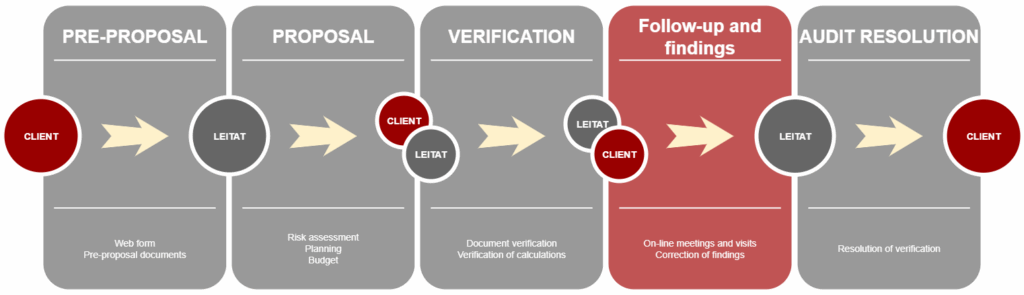
The process begins with a review of the documentation and evidence supporting the energy-efficiency measure and the savings achieved. Leitat analyses the information provided, checks compliance with the applicable requirements and verifies the declared savings in accordance with the established procedures. Once verification is complete, the corresponding report and opinion are issued within the scope of the accreditation.
Leitat offers a comprehensive support service that includes a preliminary analysis of the application, a review of the savings calculation, documentary verification and support throughout the process. As a guide, Leitat provides an initial response within 1-2 days, a review and quotation within 2-3 days, and an estimated verification period of 3-5 days, with an approximate total duration of 2-3 weeks. Time frames may vary depending on the complexity of the project and the available evidence and are confirmed during the quotation and planning stage.
Utilitzem cookies per millorar la teva experiència de navegació, publicar anuncis o contingut personalitzats i analitzar el nostre trànsit. En fer clic a "Acceptar-ho tot", acceptes l'ús que fem de les cookies.