- Five immersive experiences that demonstrate how technology transforms key sectors for the economy and society
The space of Mobile World Capital Barcelona at MWC 2026 offers a journey through the past, present and future of the city as a technological hub and innovation ecosystem. The Catalan capital brings together a unique combination of talent, research and business capacity that positions it as a laboratory where technology is tested, evolves and reaches everyday life.
At the MWCapital stand, visitors can experience in an immersive way how it promotes projects with social and economic impact. Research centres such as Leitat, leading hospitals such as Hospital del Mar and large corporations such as CaixaBank demonstrate that the local ecosystem is not an abstract concept, but a tool with concrete applications that transform key sectors.
Five immersive experiences, each linked to a strategic field — agri-food, health, future medicine, commerce and industry — explain how the technological revolution materialises into real solutions. Visitors can see, touch and interact with AI technologies, advanced robotics, big data, supercomputing and biotechnology, and discover their tangible impact in terms of efficiency, personalisation and sustainability.
The experience in the MWCapital space reinforces Barcelona’s positioning as an internationally recognised technological hub and highlights that the city continues to lead digital and scientific transformation with a practical, creative and socially relevant approach.
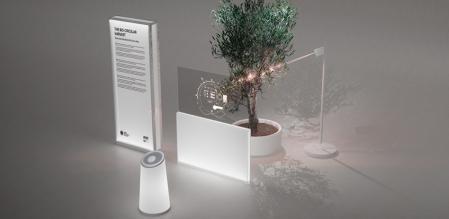
Visitors can scan a real olive tree with an interactive laser and see on a transparent screen the level of fruit ripeness and obtain information about the crop and its derived products.
Agri-food
Precision agriculture to move towards a more sustainable model
Technology also transforms the countryside. At the MWCapital stand, the Food vertical takes shape through The Bio-Circular Harvest, an experience developed jointly with Leitat that shows how digital crop scanning can improve efficiency and sustainability in the agri-food sector.
The installation places the visitor in front of a real olive tree equipped with a hyperspectral scanning system. This technology analyses the plant’s components with high precision and obtains, in real time, key data for decision-making. Through the scan, it is possible to determine the degree of fruit ripeness, the plant’s water stress level and the level of infestation — essential indicators to optimise harvesting and crop management.
The information obtained enables decisions that are better adapted to field conditions: assessing whether to advance or delay harvesting, adjusting irrigation to avoid water waste or determining the need to apply protective treatments.
This approach contributes to more efficient production and reduces environmental impact, in a context marked by resource scarcity and the need to guarantee global food security. The experience also focuses on the valorisation of olive-derived by-products. Depending on the scan results, production may generate more or fewer olives, oil or pomace, which directly affects final products such as food, cosmetics, fertilisers or biofuels. This approach reinforces a model based on circular economy and biorefinery principles, moving towards a zero-waste sector.
The application allows farmers to monitor crops to maintain moderate water stress without affecting oil yield. According to studies, this can reduce water consumption by up to 35%. Controlling the timing of harvest also makes it possible to optimise oil extraction and preserve fruit quality. Harvesting olives at their optimal stage can increase yield by up to 20%.
Through this experience, MWCapital and Leitat demonstrate how technological innovation can help the agri-food sector face future challenges based on efficiency, sustainability and environmental responsibility.