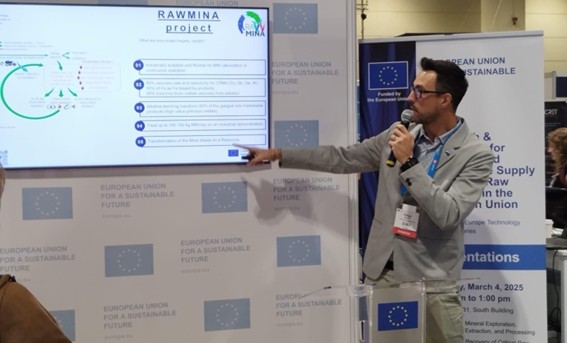
The European project RAWMINA has secured three patents to advance sustainable mining and the circular economy. Leitat has led two key patents based on Metal-Organic Frameworks (MOFs) for the selective recovery of germanium, antimony and tungsten.
The project has developed and validated a scalable industrial pilot system to valorise mining waste, achieving high recovery rates of critical raw materials and valuable metals.
RAWMINA has contributed to circular economy objectives through low-emission technologies, transforming waste into valuable raw materials for European industry.
The project strengthens the EU’s strategic autonomy and competitiveness in sustainable raw materials production and circular industrial transformation.
After 4,5 years of research and industrial-scale demonstration, the European project RAWMINA has successfully concluded, delivering an innovative solution for sustainable mining and resource recovery.
Coordinated by Leitat, the project brought together an international consortium of leading organizations—including Universitat Autònoma de Barcelona (UAB), Tharsis Mining, BETA Technological Center, AGQ Labs, Tecnalia, Universidad de Sevilla, Cobre Las Cruces, BRGM, RINA, WINGS, ELENTECBIO, Crowdhelix, INLECOM, Nano4Fibers, GEOS, VTT, and CIMS-JRI—and funded by the European Union under the Horizon 2020 programme.
From research to industrial validation
The project successfully validated an innovative pilot system at Technology Readiness Level (TRL) 7, demonstrating its operation in a real industrial environment. This achievement represents a major milestone in sustainable mining, as the system can process up to 150 tons of mine waste per day, turning environmental liabilities into valuable resources.
High recovery rates and environmental performance
Key achievements include exceptional extraction rates: 95 % for cobalt, 92 % for iron, and 90 % for tungsten, alongside optimized processes for gold and silver concentration, recovering up to 90 % of gold from bioleaching residue. These results demonstrate the system’s ability to reclaim critical raw materials essential for high-tech industries, reducing dependence on primary extraction and supporting the circular economy.
In addition, more than 90 % of the process water was recovered through electrocoagulation—a cutting-edge technique that uses electrical currents to destabilize and aggregate dissolved/suspended metals than can readily be removed efficiently from the effluent. This process not only enables water reuse but also reduces chemical consumption and sludge generation compared to conventional methods, significantly lowering environmental impact.
By validating this technology at TRL7, the project paves the way for industrial-scale implementation, providing mining companies with a practical solution to reduce waste, recover strategic metals, and comply with strict environmental regulations.
RAWMINA also addressed major challenges such as scaling up bioleaching and managing impurities in real samples. These were overcome through process optimization, including the addition of copper precipitation steps. Bioleaching emerged as a cornerstone technology, offering lower energy demand, reduced chemical use, and near-zero waste compared to conventional methods.
Leitat’s contribution to exploitable results
Leitat played a key role in developing nanofibrous composite materials and filed two patents protecting MOF-based technologies for selective adsorption of germanium (Ge), antimony (Sb), and tungsten (W) ions. The innovation and novelty of these two patents come from the EU’s increasing reliance on the import of Critical Raw Materials (CRMs) and the lack of efficient processes for their recovery that highlight the need to develop advanced methods of adsorption and separation of specific Critical Raw Materials (CRMs). Current adsorbent materials have limitations in terms of cost, efficiency and selectivity, especially for metals such as germanium (Ge), antimony (Sb) and tungsten (W). MOF-based Nanofibrous materials produced by electrospinning technique that enables the production of highly porous nanofibers that provide high surface area-to-volume ratio, high selectivity and efficiency and offers a promising approach to overcoming these challenges, providing highly effective and adaptable systems for the recovery of metals in aqueous solutions.
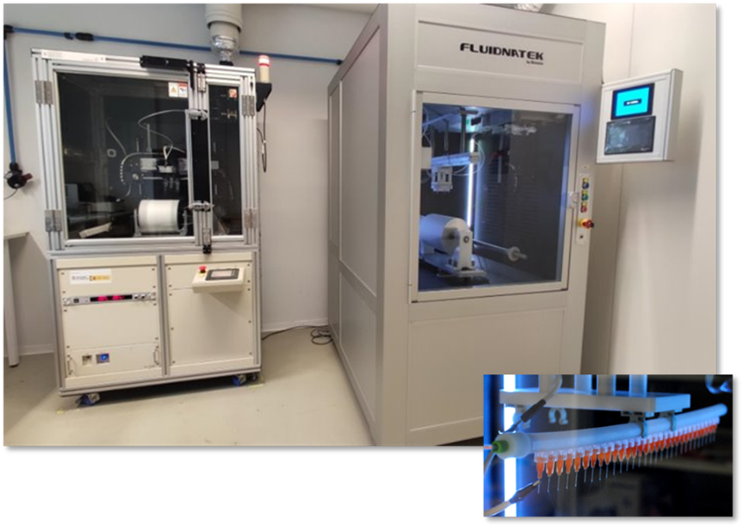
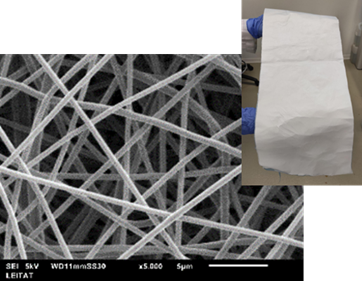
Electrospinning equipments available at Leitat facilities and example of nanofibrous mat produced by electrospinning.
These technological advances could not only reduce dependence on external supplies but also promote a more circular and sustainable economy in resource management within the EU. These innovations position Leitat with innovative technologies to support companies to be at the forefront of advanced resource recovery solutions.
RAWMINA received funding from the Horizon 2020 programme under Grant Agreement Nº 958252 and delivered policy recommendations to foster circular mining practices across Europe. Its results pave the way for future industrial applications, reducing dependency on imports and supporting the EU’s transition toward a sustainable and resilient economy.