At Leitat, we are committed to developing innovative technologies that translate advanced research into practical solutions for environmental challenges. Together with our partner Sorigué, we are pleased to announce the publication of our latest research in the Journal of Environmental Management. This work is part of the Water Harmony project, which seeks to advance sustainable, efficient, and scalable wastewater treatment solutions.
“Biocidal and photocatalytic nanofibre systems for tertiary wastewater treatment: from lab to pilot scale”
Authored by researchers from Leitat and Sorigué: Rubén Rodríguez-Alegre, María Uriburu-Gray, Rosa María Rafecas, Zulema Borjas Hernández, Carlos Andecochea Saiz, Xialei You, Beatriz Corzo, Sonia Matencio, Diego Morillo and Marcel Boerrigter.
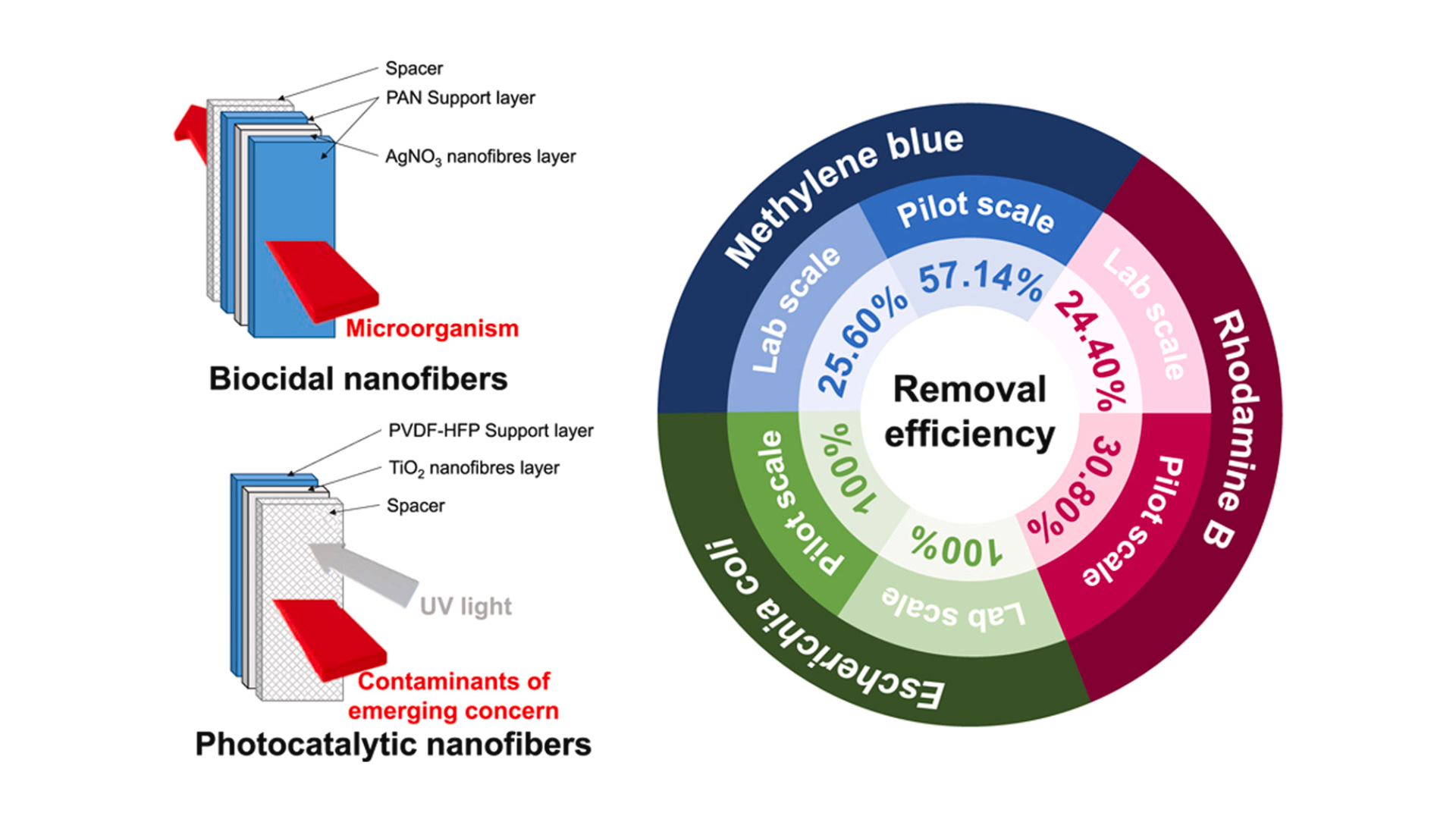
The study presents the development and validation of a modular electrospun nanofibre-based system for advanced tertiary wastewater treatment, integrating two complementary functional modules:
A biocidal nanofibre module (PAN/silver), for efficient microbial inactivation and pathogen control.
A photocatalytic nanofibre module (PVDF-HFP/TiO₂), for the degradation of organic contaminants, including emerging pollutants.
This modular design allows each treatment function to be optimised independently while operating as part of an integrated system, providing flexibility and adaptability to different treatment requirements.
A key strength of this work is its successful scale-up and pilot-scale validation. Beyond lab testing, the nanofibre system was implemented in a real municipal wastewater treatment plant, achieving high E. coli removal efficiencies and significant degradation of model organic contaminants, confirming the robustness and effectiveness of the technology in real-world conditions.
The findings highlight the potential of function-specific nanomaterials, integrated at system level, to overcome traditional barriers to scale-up. This approach supports scalable, flexible and high-performance tertiary treatment solutions, contributing to safer water reuse, improved effluent quality, and the broader goals of the circular economy.
This research demonstrates the collaborative strength of Leitat and Sorigué within the Water Harmony project, bridging materials science, environmental engineering, and industrial implementation, and accelerating the path from innovation to tangible environmental impact.
🔗 Read the full article: https://doi.org/10.1016/j.jenvman.2025.128525